
We have had clients come to us after finishing their basements with wood framing, only to be ripping it all out five years later because of moisture damage and mold. The cost to remediate and re-frame is almost always more than the original project. Metal stud framing is not just a material choice. It is a long-term financial decision, and when you look at the numbers, the case for steel is hard to argue against.
Table of Contents
- Can Moisture Really Damage Wood-Framed Basement Walls?
- How Long Do Metal Studs Last Compared to Wood Studs in a Basement?
- Is Mold Really a Risk With Wood Framing in Basements?
- Does Metal Stud Framing Add Value When You Sell?
- How Do You Find a Contractor Who Specializes in Metal Stud Framing?
- Why AR Quality Construction Ltd. Is the Right Call
- Frequently Asked Questions
Can Moisture Really Damage Wood-Framed Basement Walls?
It can, and it does. Here is the reality: basement concrete is not waterproof by default. Even in a well-built home, concrete allows vapor transmission. Ambient humidity in a basement can sit higher than in above-grade spaces, particularly during summer months when the temperature differential between the cool basement and warm outdoor air causes condensation.
When metal stud framing is not used and wood is chosen instead, that moisture has a material to work with. Wood absorbs humidity over time. The process is slow enough that most homeowners do not notice it during the first year or two. By year three to five, you may start seeing paint bubbling, baseboards lifting, or a faint musty smell. By the time visible damage shows up, the damage inside the wall cavity is often significant.
We have seen wood bottom plates completely deteriorated within four years in basements that showed no signs of active water intrusion. Vapor alone did the job.
How Long Do Metal Studs Last Compared to Wood Studs in a Basement?
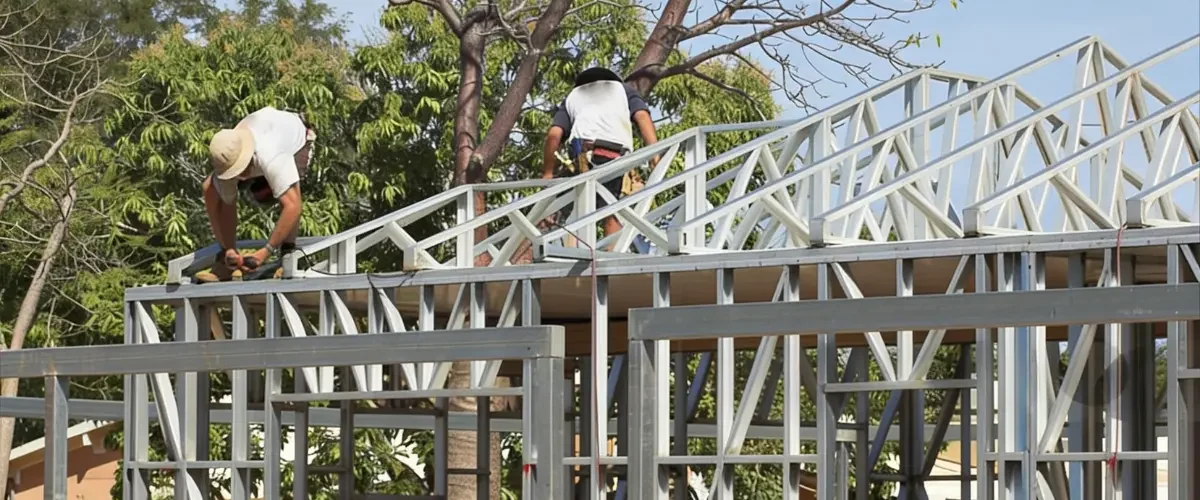
Metal framing studs used in interior, non-load-bearing applications are typically made from light-gauge galvanized steel. Galvanization is a zinc coating process that protects the steel from corrosion, as described in detail in Wikipedia’s entry on galvanization. In a basement interior environment, properly installed galvanized metal framing studs will last the life of the building, which in most Canadian residential construction means 50 years or more.
Wood framing in similar conditions has a more variable lifespan. According to the Canadian Wood Council, wood in contact with concrete or persistent humidity can degrade significantly within 10 to 20 years. The gap between these two outcomes is not just structural; it is financial. Re-framing a basement means removing all drywall, insulation, electrical rough-in, and finished flooring before you can even start.
Is Mold Really a Risk With Wood Framing in Basements?
Mold is not a hypothetical risk in wood-framed basements. It is a documented one. Health Canada identifies indoor mold as a serious air quality concern, with exposure linked to respiratory irritation, worsening asthma symptoms, and in some cases more serious health effects in immunocompromised individuals. Mold requires three things to grow: a food source, moisture, and the right temperature range. Wood framing provides the food source. Basements often provide the moisture and temperature. That combination is why basement mold is one of the most common home inspection findings in Ontario.
Metal stud framing removes the food source from that equation. Steel does not feed mold. Even in a basement with elevated humidity, metal stud framing does not support mold growth. We have never had to tear out a metal-framed basement wall because of mold. We have, however, helped clients tear out wood-framed walls for exactly that reason.
Does Metal Stud Framing Add Value When You Sell?
Yes, and in two ways. First, a finished basement with metal stud framing is an asset a buyer can trust. Home inspectors and informed buyers know the difference between wood and metal framing in a basement. Metal framing signals that the builder thought long-term. Second, metal-framed basements are less likely to present issues during a pre-sale inspection. A wood-framed basement that has absorbed moisture over the years may show problems that need to be disclosed or remediated before closing.
A finished basement can add between 10% and 30% to a home’s resale value depending on the market, according to data from the Appraisal Institute of Canada. Protecting that investment with the right framing material is straightforward logic.
How Do You Find a Contractor Who Specializes in Metal Stud Framing?
Ask specifically. Not every framing contractor defaults to metal studs, and some still push wood for basement applications out of habit rather than sound reasoning. Ask whether they use metal studs on basement projects, what gauge they use, and how they handle moisture barriers and bottom track installation on concrete.
Look for a contractor with experience across both residential and commercial projects. Commercial construction has used metal stud framing as a standard for decades because the performance benefits are well established. A contractor with commercial framing experience brings that knowledge to residential work.
Why AR Quality Construction Ltd. Is the Right Call
At AR Quality Construction, we use metal stud framing on every basement project we take on. Our clients in the GTA trust us because we explain our decisions, work to a clear plan, and deliver results that hold up over time. You can reach us through our contact information or call (647) 614-2047. If you want to learn more about who we are and how we work, we’re happy to help.
Frequently Asked Questions
Can moisture really damage wood framed basement walls and how quickly?
Yes. Even without active water intrusion, vapor transmission through concrete can saturate wood framing over time. Visible damage often appears within three to five years, though interior deterioration can begin earlier.
How long do metal studs last compared to wood studs in a basement?
Galvanized metal studs in a basement interior environment can last the life of the structure, typically 50 years or more. Wood in comparable conditions may show significant degradation within 10 to 20 years.
Does metal stud framing add value to my home when I sell it?
Yes. A finished basement can add 10% to 30% to resale value. Metal framing signals quality to buyers and is less likely to present issues during a pre-sale inspection.
How do I find a contractor who specializes in metal stud framing near me?
Ask directly whether they use metal studs on basement projects and what their experience includes. Look for contractors with both residential and commercial framing experience, and always confirm they are licensed and insured in Ontario.
Explore the Latest Metal Framing Technologies
See how the latest metal framing technologies can improve strength, efficiency, and long-term performance for your next framing project.
Explore Your Options